
Import Secrets
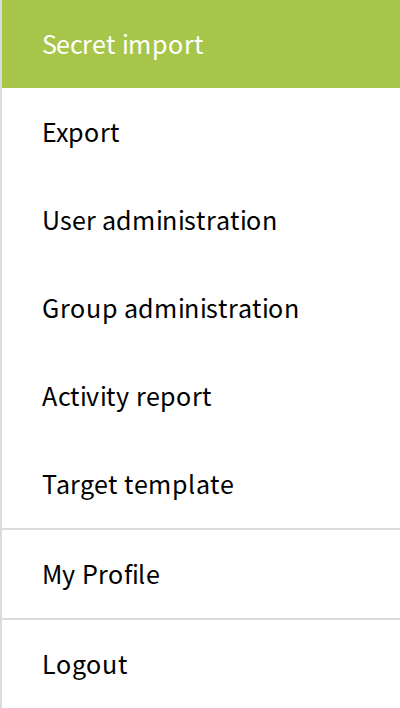
To import secrets, open the user menu in the upper-right corner, and select Secret import.
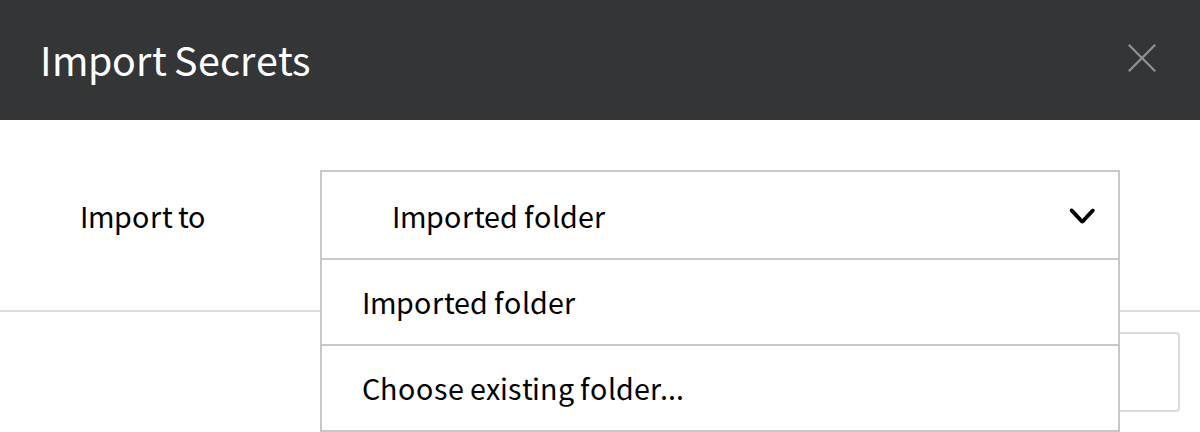
In Import Secrets, choose in Import to where the items go:
- Imported folder: the imported items are added to the Imported folder.
- Choose existing folder...: you then choose the folder to import to.
Select Next. In Import options, choose the type of your file in Import type. Password autoreset is not selected when the dialog opens (see the warning below). Then select Next.
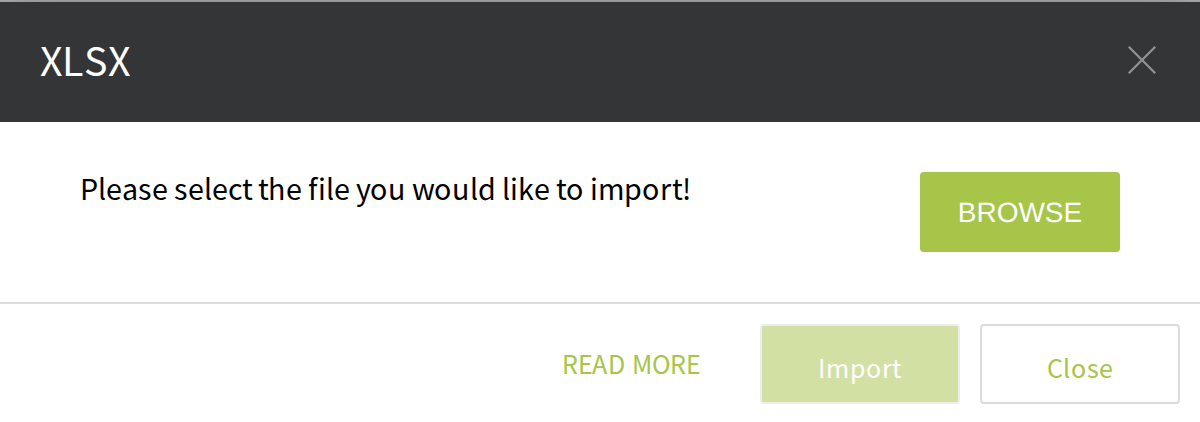
The next dialog is titled with the import type. Select BROWSE, choose the file that you prepared for the import, and then select Import.
Import types
The Import type list offers these types: Browser, CSV, KeePass CSV, Keepass KDBX (2.x), KeePass XML, PassMan Export, Pleasant Password Server, Delinea (Thycotic) Rest, URL and XLSX.
WARNING: If Password autoreset is selected in Import options, automatic password reset is turned on for all imported accounts.
We recommend that you do not turn on automatic password change in Padmin while PassMan is in its pilot phase (Padmin / System Settings / Auto pwd change).
PassMan import sample file
Required fields
- Target_type
- Target
Optional fields
- Account
- Password
- Group_path
- Description
- URL
Here is a table with the usual fields, ready to import: download the spreadsheet.
| Target_type | Target | Account | Password | Group_path | Description | URL |
| Linux | 192.168.1.2 | admin | password0 | Group0/Group1 | This is the Firewall | http://host/0 |
| Windows | windowsFS | Administrator | password1123 | Group0/Group1 | This is a file server | https://fileserver1 |
| store-only | gmail.com | cegneve | jelszoo1 | Marketing | This account is for communication about application X | |
| store-only | jirasd.cegneve.com | Admin | PassWord1 | Support | This is the central issue reporting platform | https://support.cegneve.hu |
| Store-Only | downloads.cegneve.com | Admin | passwcghuio134 | Support | This is the download server. The call center administers it. | https://support.cegneve.hu |
| CiscoIOS | central | Admin | Password397 | IT | This is the central Cisco switch |
The columns can be in any order.
More options
You can also add the OneClick (or one_click_name), SCB (or use_scb) and NLA columns.
Here is an extended table, also ready to import: download the extended spreadsheet.
| Target_type | Target | Account | Password | Group_path | Description | URL | SCB | Oneclick | NLA |
| Linux | 192.168.1.2 | admin | password0 | Group0/Group1 | This is the Firewall | http://host/0 | yes | yes | |
| Windows | windowsFS | Administrator | password1123 | Group0/Group1 | This is a file server | https://fileserver1 | yes | same | yes |
| store-only | gmail.com | cegneve | jelszoo1 | Marketing | This account is for communication about application X | no | diff | no | |
| store-only | jirasd.cegneve.com | Admin | PassWord1 | Support | This is the central issue reporting platform | https://support.cegneve.hu | default | no | |
| Store-Only | downloads.cegneve.com | Admin | passwcghuio134 | Support | This is the download server. The call center administers it. | https://support.cegneve.hu | default | no | |
| CiscoIOS | central | Admin | Password397 | IT | This is the central Cisco switch | no | yes |
The fields
Target_type is the type of the target. It defines how PassMan synchronizes the target's data.
The possible target types are Linux, Windows, Store-Only, CiscoIOS and Solaris.
Target is the name of the target: a DNS name or an IP address.
Account is the name of the account.
Password is the account's password.
Group_path is the folder, or the path of folders (parent/subfolder), where the target is. Separate the folder names with a slash (/).
If the folder does not exist, the import creates it. If no folder is given, the items go to the folder chosen in Import to.
Use Description for comments.
URL stores a link.
KeePass and LastPass compatibility
PassMan also accepts KeePass and LastPass export tables.
PassMan accepts the original column names of the source table, and renames them in the background.
If you don't use all of the columns, the two required fields must still be there.
In a KeePass table, the Notes and Title columns are required, so that PassMan can translate them.
In a LastPass table, keep the Extra and Name columns.
KeePass → PassMan values
KeePass column name | > Translation by PassMan |
|---|---|
| Notes | >Target_type |
| Title | >Target |
| Username | >Account |
| Password | >Password |
| Group | >Group_path |
| URL | >URL |
| Notes | >Description |
LastPass → PassMan values
LastPass column name | > Translation by PassMan |
|---|---|
| Extra | >Target_type |
| Name | >Target |
| Username | >Account |
| Password | >Password |
| Grouping | >Group_path |
| URL | >URL |
| Extra | >Description |
KeePass original table example
| Group | Title | Username | Password | URL | Notes |
| Group0/Group1 | 192.168.1.2 | admin | password0 | http://host/0 | linux |
| Group0/Group1 | 192.168.1.3 | admin | password1 | http://host/1 | windows |
| Group0/Group2 | 192.168.1.4 | admin | password2 | http://host/2 | linux |
LastPass original table example
Download the LastPass example.
| Grouping | Name | Username | Password | URL | Extra |
| Group0/Group1 | 192.168.1.2 | admin | password0 | http://host/0 | linux |
| Group0/Group1 | 192.168.1.3 | admin | password1 | http://host/1 | linux |
| Group0/Group2 | 192.168.1.4 | admin | password2 | http://host/2 | linux |
So the target type is essential, and it must be filled in so that PassMan can recognize each type.
Because LastPass and KeePass export files have no Target type or Type column, the target type goes in the Notes column (KeePass) or the Extra column (LastPass).
In this case, the comments in the source table (the Notes and Extra fields) are lost!
To keep the original comments, rename the table's columns.
Source tables with extended columns
Add a Target_type column, and fill in the type for each account. Then rename the other columns as follows.
KeePass:
- Group → Group_path
- Title → Target
- Username → Account
- Notes → Description
LastPass:
- Grouping → Group_path
- Name → Target
- Username → Account
- Extra → Description
More import types
- Pleasant Password Import
- Import from URL
- Thychotic Rest Import
- Import from Thycotic .CSV export
- Thycotic data exported to a .CSV file must be imported as a .CSV file. PassMan recognizes it as a Thycotic export from the file header.
- Import passwords from a browser (for example, Google Password Manager)
WARNING: If Password autoreset is selected in Import options, automatic password reset is turned on for all imported accounts.
We recommend that you turn off automatic password change while the system is being set up (Padmin/System Settings/Automatic Reset).
To create an import file by hand, see PassMan import templates.
WARNING!
Each account of a target needs a UNIQUE NAME.
The header of the table must be in the first row of the spreadsheet.
Column names must follow the patterns on this page.